ClaimBound In 5 Minutes
ClaimBound turns a public claim into a small evidence card.
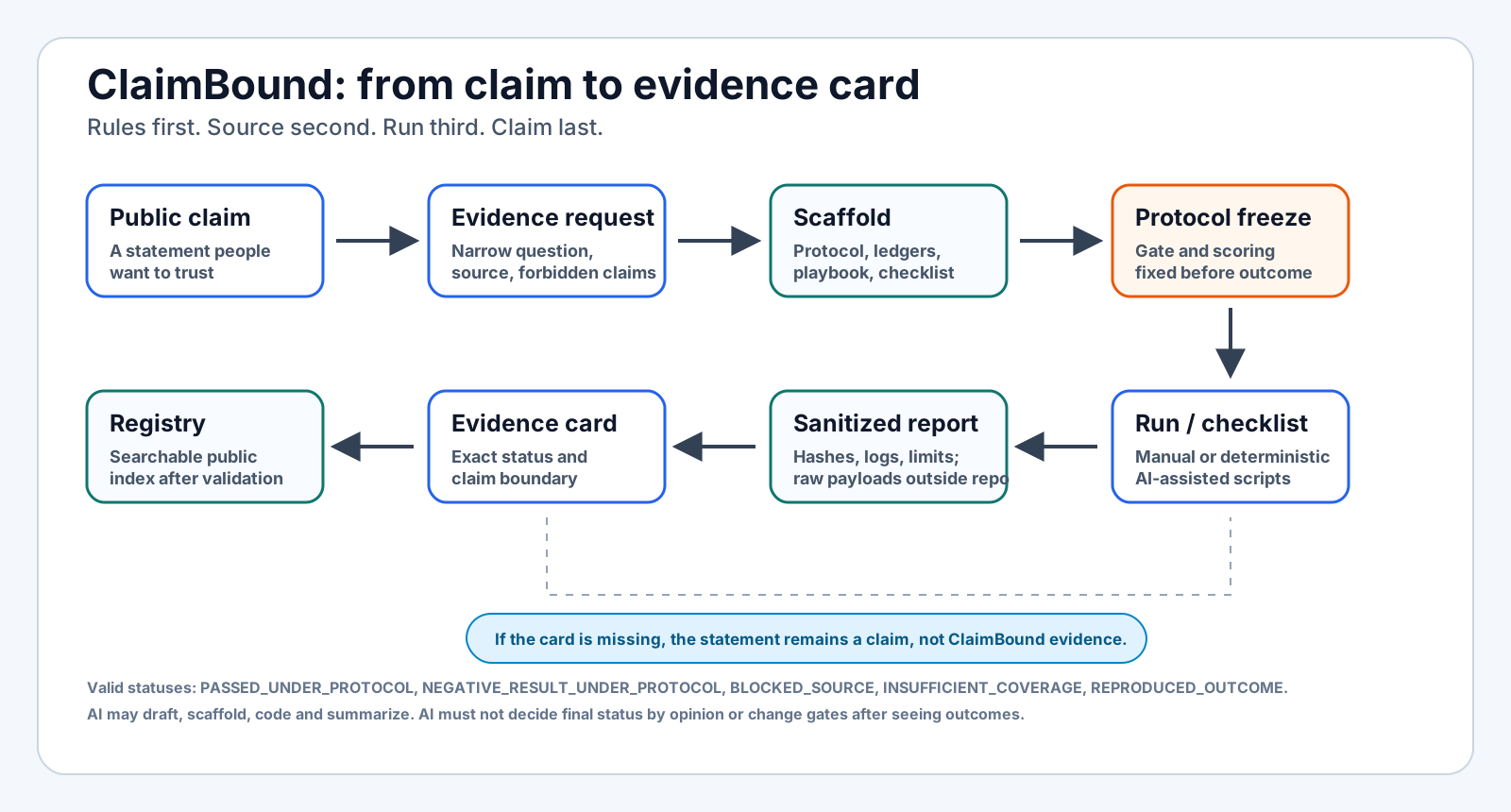
If there is no evidence card, the statement is still only a claim.
The Idea
People make public claims about AI systems, models, datasets and methods. A ClaimBound card asks whether one narrow version of that claim was checked under rules fixed before the result.
The card records:
- the exact claim;
- the public source;
- the frozen protocol;
- the result status;
- the hashes and sanitized report;
- the boundary: what the card proves and what it does not prove.
ClaimBound is not a leaderboard, certification authority, newsroom, raw-data archive or blockchain project. It is a thin evidence layer between a claim and a public source.
For AI-assisted work, that same evidence layer can be read as 12 AI Life Rules: AI may assist, but the trusted claim or action still needs a boundary, source, frozen gate, blocked-state policy, audit trail and human review when the action requires it.
One Simple AI Example
Public claim:
Anthropic publishes a public system-card index for its AI models.
ClaimBound question:
Can the official Anthropic system-card page be source-audited by URL, access
date, content type, expected markers and SHA-256?
Card status:
PASSED_UNDER_PROTOCOL
Allowed interpretation:
The public source page passed the documented source-audit gate at access time.
Forbidden interpretation:
This does not prove model safety, model quality, runtime behavior, deployment
readiness or benchmark superiority.
That boundary is the point. A useful card can be green without becoming a broad endorsement.
Statuses In Plain Language
| Field | Plain meaning |
|---|---|
PASSED_UNDER_PROTOCOL |
It passed, but only under the written rules. |
NEGATIVE_RESULT_UNDER_PROTOCOL |
It was tested and did not pass. |
BLOCKED_SOURCE |
The source, access, metadata or rights boundary blocked a fair result. |
INSUFFICIENT_COVERAGE |
The source exists, but there is not enough usable coverage. |
reproduction_level: REPRODUCED_OUTCOME |
Another run reproduced the gate-level outcome. |
reproduction_level: REPRODUCED_OUTCOME_WITH_SOURCE_BYTE_DRIFT |
The gate-level outcome reproduced, but fresh source bytes differed. |
Negative, blocked and drift-limited cards are useful. They stop weak claims from being renamed as successes.
The Workflow
- Write a narrow public claim.
- Open an evidence request.
- Generate a scaffold: protocol draft, playbook, checklist, family ledger and draft card.
- Freeze source, claim list, scoring, gate and stop rules before outcome inspection.
- Run a manual checklist or deterministic script.
- Keep raw payloads, prompt text and transcripts outside the public repo.
- Publish a sanitized report with hashes and limitations.
- Validate the evidence card JSON.
- Validate family and frontier ledgers when related tracks are involved.
- Add it to the registry only after validation.
Where To Start
- Non-developers: start without coding (Windows/macOS/Linux).
- Browse the evidence cards.
- Follow getting started for installation and commands.
- Use
uv run claimbound newto create a scaffold. - Use
uv run claimbound validate-family ...andvalidate-frontier ...for related R&D tracks. - Use
uv run claimbound validate-allbefore publishing cards.